Friday, December 12, 2014

Journey to the Top of the Mountain and the Bottom of the Killing Cave . . .

Earlier today, we rode the Bamboo Railway, and now we're headed on another out-of-town adventure - a visit to the Bat Cave and the Killing Cave.  No, Bat Man and Robin do not live in the former; rather a colony of several million bats (think Carlsbad Caverns) and coming here at dusk is a frequent tourist trek.  We've decided to take a pass on that but here's a shot of the Bat Cave from our tuk tuk.


Our ultimate destination is the very top of this mountain; you can just make out the spires of the Buddhist temple we plan to visit.


The last stretch of road is too steep for our tuk tuk so we need to hire a couple of scooters and their drivers to get to the temple and the Killing Cave.   We only hesitate for a few seconds, and the deal's done and we get our helmets!


It's only a couple of km to the top but it's steep, very steep, and we're glad we opted for the scooters rather than attempting to walk up (that was suggested as an option!).  And here's the temple, a remarkable structure; every surface is illustrated with scenes from the Buddha's life, his followers, his mother, his sister . . . just about everyone gets in on this action.  


What's so remarkable is that this temple was nearly destroyed by Pol Pot and the Khmer Rouge; all the monks were assassinated.   

Then farther up the path, we come to the Killing Cave, so named because of its purpose during the reign of the Khmer Rouge.  This area of Cambodia was one of the last holdouts for them, and there are people today who think there are still some of them still hiding out . . . 

Yes, those are human bones . . . 


There is a sweet little settlement at the very top of the hill with a spectacular view of the surrounding rice fields (no, they're not called paddies).  


And one of the drivers points out a bizarre addition to the landscape - a Russian howitzer.   Our scooter driver tells us that the Russians were invited into Cambodia to help drive out the Khmer Rouge and this gun was aimed at a neighboring hill; there was a Khmer Rouge aimed from that hill back here.  

I'm starting to feel like I did in Croatia - a scorecard wouldn't begin to help an outsider in this part of the world.  Warfare here goes back so far, is so complicated, and allegiances seem to be written in the dirt but set in stone.  And somehow, the people have survived . . . 

Tomorrow we go to Phnom Penh, our final stop in Cambodia.  We've been warned, and warned again, about tourist muggings so will be extra cautious.  Have booked a luxurious stay ($50USD/night) and may just cocoon there.


Sunday, December 7, 2014

The One and Only Bamboo Railway

When you read the description of the Bamboo Railway in the LP guide, your first thought is  - huh??  That was our response but Paul and Debbie, our professional advisors, insisted we do this.  Let me see if I can describe this and add photos as I go . . .

This is a 'major' attraction in Battambang; it's at the end of a pot-holed, dirt road about 20" out of town.  A small settlement appears to have grown up around it, and a very official-looking man charges us $5 each to ride the rails.  It's early and we're two of only a couple of riders.  We're told to hop on our own 'car' and, of course, smile for the camera.


Our driver - engineer?

A little background on this 'railway' - it was built over 100 years ago by the French to transport rice to market.  Maybe it was the departure of the French (Cambodia declared its independence in 1953) or more efficient forms of transport, but it fell into disuse to transport rice some time ago until someone realized its unique tourist potential . . .

The driver starts the engine with a pull cord and has a braking mechanism (that pole in his left hand) that somehow regulates the speed (I think that fan belt has something to do with it).  Now here's the amazing part - there's only one set of tracks.  When you meet a train coming towards you, passengers get off,  and the two drivers literally take the 'train' apart.


The platform gets laid on the ground, the wheel base(s) comes off, tossed on the ground, and the priority train goes ahead.  The 'on' train driver then helps the 'off' driver reassemble his train and everybody's on the rails again.


The 'on-off' protocol is that the outbound train always gives way to the home-bound train so everyone seems to know (and follow) the rules.


The whole journey takes about an hour - 20" to the terminus, 10" to walk around the stalls set up for tourists (Tim manages to find a brick-making factory down a short dirt road),

and 20" for the return journey.  Tim thinks we get up to 25-30 mph on the straightaway!  Pretty good clip to be hurtling through the bush.  We do make one stop to survey the rice fields (they don't call them paddies) and check out the fishing techniques (simple purse seine idea operated by man-power)


And then we're back where we started.

We spend a few minutes talking to one of the drivers whose English is quite good (many people we meet speak little or no English), and he tells us that the Bamboo Railway's days may be limited.  The Chinese are planning to close it down and in its place build a 'real' railway that would take passengers to Phnom Penh and probably other points south.   He also tells us that 'management' of the railway is a daily perk for as many as 40 local men.  Whoever is the 'manager' for the day pockets the proceeds and drivers depend on tips from tourists.  

More of today's adventures in the next blog . . .

More Than A Little Bit of France (and Italy) in Cambodia

Our friends and travel advisors, Paul and Debbie, have insisted we stop in Battambang - glad we listened to them.  We negotiate the rather funky ferry terminal (which meant scrambling off the boat via the front deck, making our way up concrete steps hanging over the river bank), we're met with an Indian-level of tuk tuk drivers waiting for customers).  Our very own hotel-dispatched driver is there, and soon we're on our way to our hotel, the King Fy (we say 'fie' but are told it's pronounced 'fee').  It's been a very, very long day but we engage our tuk tuk driver, Buntha. for a tour the following day.
--------------------
We've decided to check out the French colonial part of town (we're across the Bassac River somewhat in the 'burbs'), including the 'art' quarter.  By way of background, Battambang (pronounced BattamBONG) is the second largest city in Cambodia, and prior to the Khmer Rouge, was considered the intellectual, artistic, and cultural heart of Cambodia.  Pol Pot took care of that distinction and, oddly, the last remnants of his soldiers fled to the surrounding hills.  It wasn't until the late 90's that the last of them were rooted out (some people think there are still some of them in hiding).

We find a couple of struggling art 'galleries' and land at the Choco L'Art for a much-needed French press coffee.  Soon it's time to eat and we head to Daido, back across the river. It's like stepping into another world.  Daido is owned by an Italian surgeon, Nicola, who came to Cambodia about 10 years ago to assist in Battambang's hospital and liked it so much he stayed . . . and opened a restaurant.  We were dazzled by the setting, the service, and, of course, the food!


Nothing quite gets Tim's attention like a good bowl of pasta with a pomidoro sauce and a side of grilled peppers in anchovies.  I had the pumpkin gnocchi - superb!  Lovely end to a most intriguing day.

Tomorrow, the Bamboo Railway!!


Friday, December 5, 2014

Rollin' on the River

Lonely Planet, a Shoestring Guide to Southeast Asis has been our reference point for much of this trip, and taking the boat from Siem Reap to Battambang, our next stop, is something the authors highly recommend.  Our guesthouse host, Reinhart, is very dubious about our decision but orders the tickets anyway with a request that I email him with my impressions of the trip.

Another one of these God-awful early pickups (6:30) but the van doesn't arrive until almost 7:30!  We're the last ones to be picked up - nine of us and a bunch of luggage.  It should take about 20-30 minutes to get to the ferry terminal, but about 5 minutes after we're picked up, the whole lot of us are told to disembark at a traffic circle downtown and 'another bus will be along to pick you up'.  Huh?  Close on an hour later, a van just like the one we got off arrives and there are three open seats.  The driver tells us all to 'get in, there's room' and all but three of us flatly refuse and demand another van.

Wait another 15" or so and lo and behold our original driver turns up with another van (empty) and we all pile in.  It's now well past 7:30, the time the ferry to Battambang is due to leave but since nearly all of us in the van are going there, maybe we have some leverage.  Finally, after a detour down a dirt road full of potholes, we zoom into the ferry terminal (a curiously modern, partially-completed concrete wonder) and all pile down onto the dock and are directed to our ferry.

Talk about outdated!  This is right out of African Queen, except I think Bogie at least had flotation devices for himself and Kathryn Hepburn.  (Little did we know that was our 'lunch' hanging in the green plastic sack.)


Fortunately - very, very fortunately - we get a seat downstairs, right behind the 'captain' with a terrific view.  The seats are wooden, very hard and this is a long, long ride - 7 hours!  We'd been told there would be a 'lunch stop' but just in case we've brought a bag of snacks with us and lots of water.

Yes, this youngster's shirt said 'I Could Be Your Son'.  Mmmm . . .

Latecomers scrambling to get on what looked like a much more sea-worthy craft, probably the one headed all the way to Phnom Penh.

And we're off, headed first across the top of Tonle Sap, an enormous lake that is the source of rich soil for agriculture all around it.  When the monsoons come, there is so much water in the rivers that feed this lake that they actually flow backwards and fill the lake with super-rich delta soil from the Mekong which is one of its outlets.


We can't even see the other side of Tonle Sap . . .


View from the back of the boat.  that's our 'captain' on the left, with the baseball cap (not a flotation device in sight!).

Didn't seem to bother this sweet little girl . . .

This is our 'first mate' who yells directions to the captain and helps steer this big clunky boat through a series of very narrow canals.  He uses a big wooden pole, not unlike that of a gondolier - the big difference is our mate uses it at the front of the boat.  A most curious adaptation . . . 


And in no time we're making our way into this labyrinthine waterway . . .
Almost forgot, this is a delivery craft as well and those packages are destined for the floating villages along the way.  The first group comes up almost immediately . . .


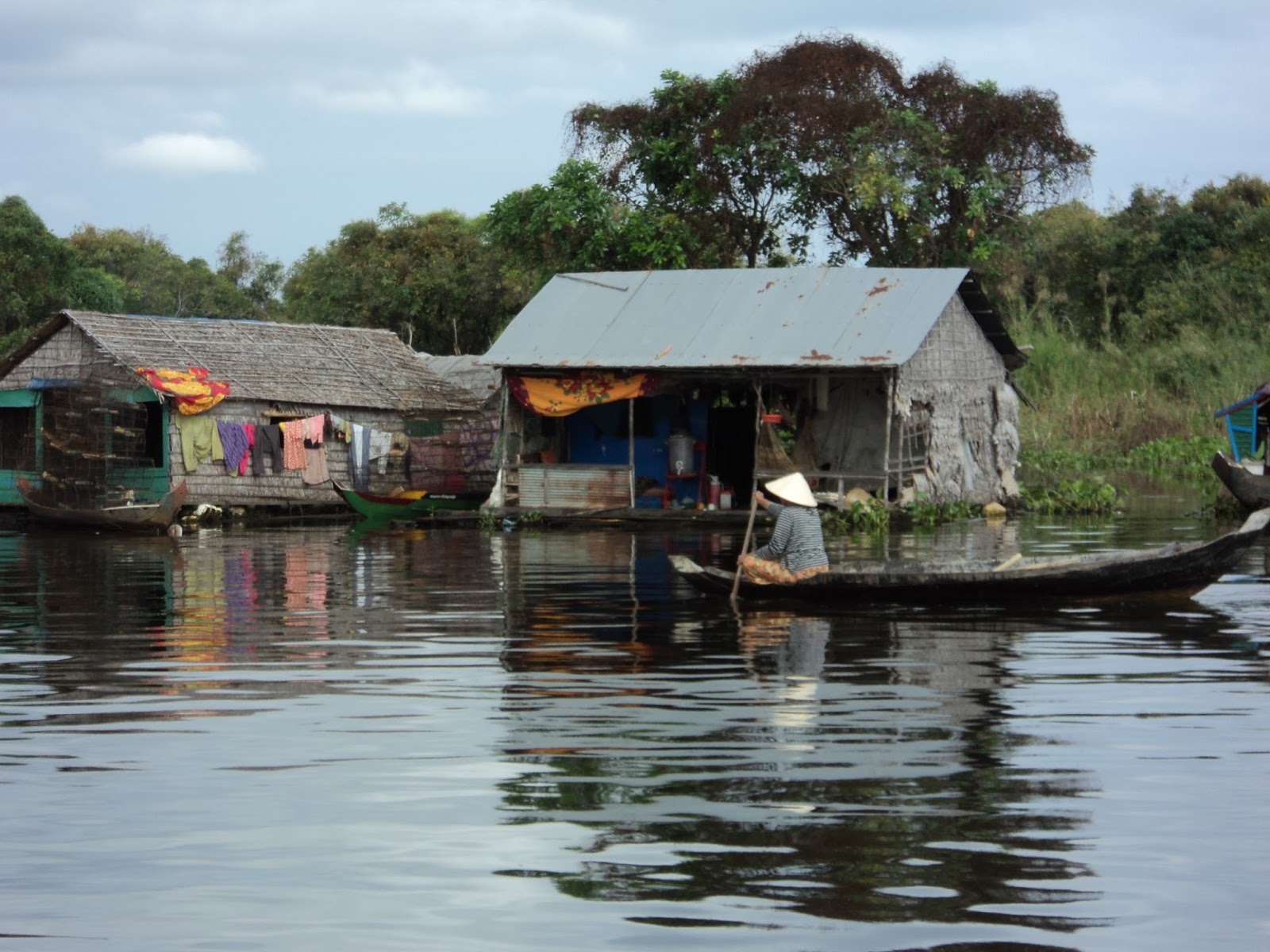
Yes, these are floating homes, 50 gallon flotation devices and all.  They don't seem to be moored or anchored to anything but somehow they stay in place.  No running water, no electricity, no mod-cons.

But wait, here comes a floating 7-11!


Many of the floating homes we passed had a 'fast boat' tied out front, similar to the ones we saw on the Prao Choya River in Bangkok, just smaller.  

We rode for the next 5+ hours past village after village, some of which looked pretty prosperous, some of which rivaled India in poverty and despair.  Here is a sampling of the many, many photos I took . . . 


This house was built on these towering concrete pillars and it still fell apart!

One of the deliveries along the way.  The captain sounded his horn and this boat pulled alongside of us, and this woman and her baby climbed down into it and they all drove away.


And then we're back in the weeds again and a slight miscalculation on the part of the captain(?), we're headed straight for a boat!  Near miss . . .


Got everyone's attention . . .


The first mate is at the other end of that long pole, trying to push us off this mess of underbrush and flotsam.

Mamasan passenger hops up on the deck to help out.


And our seat mate across the aisle lends a hand while Mamasan manages the steering pole.  I think the first mate jumped ship!


Somehow we manage to get ourselves out of that mess - only slammed into one poor fishing boat/fisherman's home which I think did some damage to his metal corrugated siding - and are finally in the home stretch into Battambang.

Sadly, these are the most depressing 'homes' we passed . . .


We actually saw people living on the banks of the river under plastic lean-tos . . . the floating homes were just a half-step above that.

This was a very, very long day.  Our lunch 'stop' was a loaf of bad French bread handed out some time around noon.  Drinks and water were for sale.  The seats were beastly uncomfortable, the engine is noisy and stinky and safety procedures and equipment are non-existent.  All that said, it was a once-in-a-lifetime experience.  We would not have missed this, and we both need some serious butt massages!!  We were so grateful that the weather was perfect - overcast and not too hot.  If it had rained (as predicted) or been hot and humid, it would have been quite a different matter.  It didn't and we had the trip of a lifetime.