Friday, December 5, 2014

Angkor Thom, Lara Croft,Tomb Raider, and Tolkein Trees

How often our point of reference for a historical site is based on seeing it for the first time on film!

Today's temple tour (the part we wimped out on yesterday after the sunrise excursion) includes Angkor Thom (doesn't quite have the ring of Angkor Wat) which makes AW look like a warm-up exercise in temple building.  On the map it's about six times the size of AW and in design, it knocks AW right out of its waterlily-filled moat.

The centerpiece of Angkor Thom is Bayoun Temple (aka Temple of Tomb Raider fame).  It's in far better shape than AW and it's been suggested that it was built almost entirely of sandstone, rather than the laterite (laterine?) used in many of the temples which is not not nearly as durable.

Our first view of Bayoun . . .

This temple is undergoing extensive restoration/rehabilitation; it's the first time we've seen actual cranes on site (that's the white angled arm on the outside of the wall) .

This temple is overwhelmingly Buddhist - I think I heard a guide describe it as 'the temple of a thousand Buddhas'.  An exaggeration no doubt but Buddha's smiling face is everywhere we look, sometimes on four sides of a pedestal facing all four directions.


We had to stop and take a photo with this Buddha profile.


This may be the very best set of Buddhas we saw.


This temple was full of surprises!


More photos of the incredible interior . . . 


And this one thanks to a lovely Chinese couple for whom I took a picture of them!


On to the next temple in Angkor Thom!


Definitely a change in architectural style . . . 

We take a pass on the climb and head around the side . . . and find one of many wee passageways into the inner courtyards of every temple.  It looks like every one of these doors through the perimeter walls could accommodate one elephant and rider.  Yes, the opening is that big and these walls are amazing.

And the ever-present, ever-ready to reclaim the jungle, banyan trees.

And a temple that is distinctly Mayan in structure . . . on our map it's labeled the Royal Palace (quite a climb to get to it!).


And the Terrace of the Leper King . . . recently determined to be a crematory/burial site.


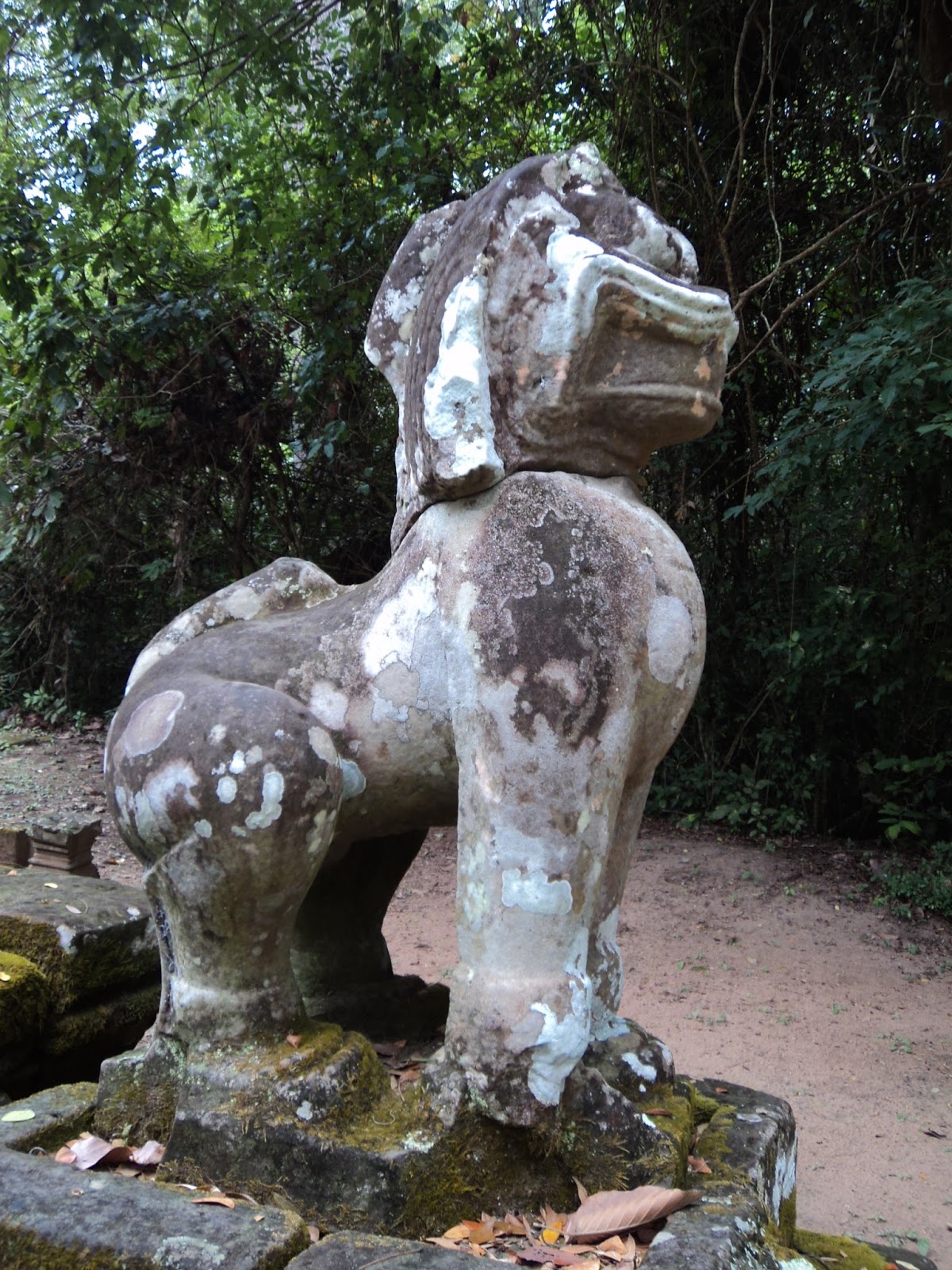
Dragon statuary adorn many of the temple approaches . . . 


And Tolkien trees adorn most of the walls . . .

We emerge from our walk through the temples in the woods and find a living, active Buddhist shrine.

And our very last temple on this incredible tour, Ta Prohm.

Restoration of Ta Prohm has been jointly undertaken with the Government of India - a number of 'before' and 'after' photos show the results of their efforts.  One was of this walkway - an 'after'.  

This ruler was undoubtedly Hindu - this relief could have come right out of one of the temples we saw in India.

But the most spectacular feature of this temple isn't man-made, it's nature, reclaiming the jungle.  These banyan trees could be hundreds of years old. 

I swear once I turned my back they started growing and stopped as soon as I turned around and looked at them again.  Definitely not on my list of trees I want to hug!

Some of the root systems looked like someone had upended a giant bowl of spaghetti and then had it flash frozen.

Ta Prohm is a much, much smaller temple with a series of unfolding chambers.

We leave, looking through yet another passageway, ornamented with the work of craftsmen long gone.
I wonder if we will ever know the whole story of Angkor Wat.  It is deservedly one of the Seven Wonders of the World , , , 

Thursday, December 4, 2014

Sunrise at Angkor Wat . . Sort Of

At 0 dark thirty we're in the tuk tuk on the way to watch the sunrise at Angkor Wat.  Us and about a thousand others!  The water is one side of a moat that completely surrounds the Angkor Wat (the whole complex of temples is called Angkor Wat so it can be confusing).  Our guest house host tells us that this is about 30% of the viewers that show up during 'high' season.  The best story is of someone wading into the moat up to their thighs, holding their camera up to get a shot without any reflections of people in it!


This morning it's overcast (makes for a much nicer visit but not such a great sunrise).


People started leaving about now so we concluded this was 'it'.  Okay, time for a trip across the moat into the temple.  Uncharacteristically, this temple faces west, leading some scholars to speculate that it was built as a final resting place for the King.


This temple is one of the latest in the whole complex and reflects the transition from the Hinduism of the builder ruler to the Buddhism of later rulers.  


One portion of a very long panel (100+ feet long) that depicts various conquests of its builder (Jayavarman VII?)

The long portico at the front of the temple.
And the part of the temple reflecting the Buddhist transformation . . . including an on-site monk selling incense.


An area believed to be part of the library.


Inside the outer walls, a spectacular interior.


Another view of one of the outer wall structures.

And a couple of views of the wall.


And the long view, pink blouse and water lilies . . . 


Definitely time for that second cup of coffee . . . off to the temple-side cafe.  


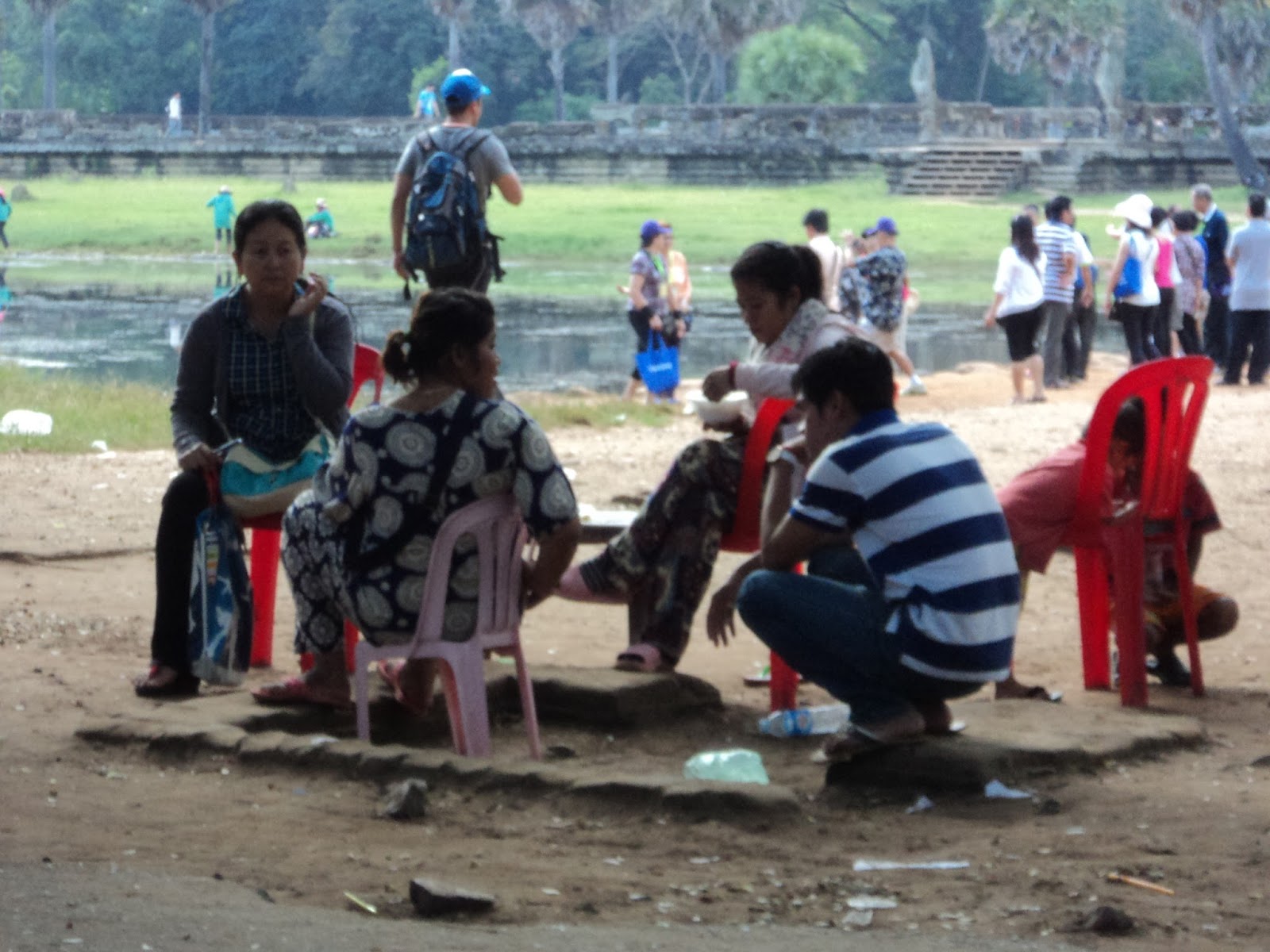
There are even touts who recruit you to their cafe tables . . . all imaginatively named.


And even more people (and children) attempting to sell stuff to tourists.  I know, I know I'm starting to sound like I'm beating a drum here, but we've heard over and over that teachers make the equivalent to about $80 a month and they can only afford to 'work' about an hour a day.  Anything over that is 'private' and paid out of a parent's pocket.  There aren't too many people in this poor country who can afford that so we see all these school-age children out of school . . . 


The sun is well up, we're well spent, once again overwhelmed with the wonders of AW . . . our lovely tuk tuk driver, Rom, is all set to take us to the rest of the temples on the 'short tour' and I'm sure we disappoint him by telling him we're ready to head home!  We can see the others tomorrow . . . for now, we need food and a nap.


Wednesday, December 3, 2014

The Phare Circus

Pickup at 5 a.m.???  Yup, if you want to get a good 'seat' for the highly-promoted sunrise at Angkor Wat, that's when we need to leave our guesthouse.  Tim checks the local data and learns that sunrise is actually at 6:20 so we must be one of many (thousands??) as the drive to AW only takes about 15-20".  Not our idea of a time to get up (actually getting up is at 4:30) but when in Siem Reap . . .

We've already made plans to go to the Phare Cambodian Circus tonight so we'll just have to suck it up for tomorrow morning.  The Circus turns out to be a delightful and totally unexpected surprise.  It is a group of young acrobats who enact the story of Sorkhla (sp?) who as an old woman remembers the traumatic events of her life - especially the horrors of the Khmer Rouge years - and ultimately affirms the power of life and love over death and evil.

The Circus originated in Battambang as part of a healing effort to help children who'd been traumatized by the Khmer Rouge years.  Many were orphans and had witnessed unbelievable horror.  For some of the children, the traditional healing therapies were not working, and someone had the brilliant idea to begin doing acrobatics with them and the rest is history . . . now many years on, this troupe not only helps children, it supports schools, and helps their families who benefit from the children's success.  In addition to acrobatics (which they call a circus), there is a painting program, and a music program.

This troupe (I think there are several performing troupes) consisted on 7 young people - 6 men and a woman.  Using a minimum of props, a small orchestra, and the incredible athleticism of their bodies, they dramatized the major eras of this woman's life and contemporary Cambodia.  Each era was preceded by a poster-sized drawing - made on the spot - of the defining elements of the time, starting with a Buddha, moving to the bombing in the late 60's (thank you US), to the Khmer Rouge era, and ending with a tranquil landscape - modern-day Cambodia.

Photographs were prohibited during the performance but I did take one of the banner outside the tent.  It was a full house and a very enthusiastic audience - lovely evening!!


The Long Tour of the 'Lesser Temples' of Angkor Wat

It is impossible to describe the size,  scope, and splendor of Angkor Wat.  Suffice it to say, one of the pass options is for 7-days.  We get a 3-day pass and even then we don't begin to cover - much less absorb - anything approximating the wonder that is Angkor Wat.  This is one of the few times that I would have been been willing to pay for a helicopter tour which would be a spectacular way to see and appreciate AW.

A brief history:  at its peak (late 15th - early 16th c or so), the Angkor /Khmer Kingdom had a population of over 1 million people.  By comparison, London's population at the same time was around 50,000.  Angkor Wat is the largest religious site in the world and reflects a building boom that started in the late 800's AD, reached its peak in the mid-12th century with the building of AW, and then continued until the end of the Khmer kingdom in the early 16th century.   There are so many temples, revealing so many reigns, and so many religious fluctuations, it is the work of a lifetime to understand them.

Interestingly, early French explorers were instrumental in securing AW for Cambodia, and it wasn't until 1953 that Cambodia secured its independence from France.  (Please don't quote my dates or history - I think I've gotten the basics right!).  It is now one of the Seven Wonders of the World - and rightly so.  I've not found anything that explains what happened and why the Khmer Kingdom waned . . .

At the recommendation of Reinhart, our guesthouse host, we start with the 'Long Tour' which takes in six of the surrounding temples near AW.  (There is also an all-day tour which goes 50 km or so to the distant temples which gives you some idea of the scope of the whole site.)  Rather than give you the names of each of these, I'll simply show you the photos . . . and keep in mind, these aren't the 'biggies' of Angkor Wat and Angkor Thom!!


An example of the efforts to prevent even more deterioration.


Experts think that the stones for all the temples may have come from as far as 50 km away!


Just one example of the heroic deeds of one of the rulers immortalized in stone.


Notice the cornice molding around the doorway - something we saw nearly everywhere in the temples.


Banyan trees reclaiming the jungle.


Reminded both of us of a rather traditionally-shaped Christian church . . . 


Walking causeway to what was believed to be a ritual cleansing temple.


On the return, we pass by a ramada with a group of men playing Khmer instruments.  The men are all missing limbs . . . victims of land mines.  We make a contribution.


Tolkien trees are everywhere . . . 


And a couple of the children we saw at the temples . . . sadly, not in school but acting as touts and able to count in a couple of languages, trying to sell us postcards ('ten for one dallah, madame').


And this sweet little one whom we heard humming and had to hunt to find her sitting in this opening . . .

It's hard to believe that this is just a sampling . . . we've been to six temples today, are aesthetically overwhelmed, and absolutely amazed.  Estimates are that there was more stone used in building Angkor Wat (the whole of the site) than in the pyramids of ancient Egypt.  I'm a believer . . .