Sunday, October 18, 2015

Now This is a Palace!

We spent six weeks in France in the late spring of 2013, had a fabulous time, but left a couple of important sights 'unseen'; Versailles was one of them.  Fortunately, we've come on a day when it's not mobbed with tourists but still warm enough to be enjoyable. This is definitely the crown jewel in France's attractions . . . just walking up to it provokes a jaw-dropping response from both of us.  What an incredible sight!  Yes, everything you see in this photo is part of the Palace.


A bit of history before the photos . . . Versailles was originally a somewhat modest hunting lodge, a favorite spot of Louis XIV's father.  Louis XIV became King in 1715, and once he attained adulthood, made some radical changes, including moving the seat of government here from the Louvre in Paris only 10 miles away.  Why did he do this?  Not surprisingly, his reasons were both political and personal.  He was tired of the stuffy, sniping environment in Paris, and he loved the outdoors.  It also gave him the setting and opportunity to consolidate power; all his nobles were 'invited' to join him at Versailles which became both the royal residence and the seat of power.  Smart move, Louis.

The nobles, now living a life of enforced idleness, couldn't interfere with Louis's ventures.  France and French culture became 'the' culture of Europe.  Everyone learned French, imitated French fashion, hair styles, architecture, and French customs (including kissing!) and when you said 'the king' you meant Louis XIV, no one else.  Fortunately, Louis was what we would probably call a good guy.  He had the common touch but was a true Renaissance man.  He was an outstanding musician, horseman, statesman, patron of the arts, and what we would now term 'eye candy'.  The guy had it all, but he was also approachable, a good listener, and according to the audio-guide, even the common folk loved him. No wonder that he sat on the throne for 70 years!  Known as 'The Sun King',  Louis spread life and warmth to all he touched.

Nobody has any memoirs of the peasants who probably toiled endlessly to make The Sun King's life one of ease and luxury so who knows if the love of the common folk is true or not.  It's a nice fiction, and Versailles is certainly one of the architectural wonders of Europe, if not the world.  We all know that his grandson, Louis XVI, did not enjoy any kind of affection from the common folk.  It's rumored that when confronted with the graffiti signaling widespread unrest in the empire, he lost sleep over the fact that it contained misspellings!

Enough history, now some photos . . .

The first thing you see after clearing the security screening (not quite TSA but pretty rigorous) and entering the Palace is the Royal Chapel.  Apparently, Louis was a stickler for protocol and went to chapel regularly; the members of his household had to line up in a certain order and Louis would not make his grand entrance until everyone else was inside.


This room, part of the State Apartments was another jaw-dropper.  The painting on the wall, a gift from an Italian painter (sorry, I forgot his name) is huge; it depicts the meal at Simon's home when an unknown woman (Mary Magdalene?) whom the other guests call a sinner, washes Jesus's feet with her tears, dries them with her hair, and then anoints them with oil.  This painting must be 20' by 30' - it's enormous and very impressive.  To set it off, Louis ordered the ceiling painted with a series of scenes from Jesus's life and the combination is amazing - rivals the Sistine Chapel ceiling.


A closeup of the painting, above and the opposite side of the ceiling, below.


The famous Hall of Mirrors.  The French were beautifully dressed, perfectly coiffed, and for the most part a pretty good looking lot.  They loved to look at themselves; the more mirrors the better.  Mirrors were pretty much a luxury then; this hall of 17 arched mirrors matching 17 windows was extraordinary for its time.  The mirrors reflect the garden views which can be seen through the matching windows. It's sobering to remember that the Treaty of Versailles, ending World War I, was signed here.


The ceiling's pretty impressive too.

And the boudoir of The Sun King.  Gold, gold, and more gold . . . nobody's explained what those wee stools were for.

I think this was the make-out room (that was from the guide).

View from one of the corridors. If I remember correctly, there were something like 1500 members of Louis's 'court' stationed here.


Every door and window came with one of these ornate latches.  Amazing to think of the time and person-hours that went into building this place.  Every one of these window latches was hand forged.


And the Palace from the rear, as we get ready to board the shuttle to Marie Antoinette's Petit Trianon Palace.


After Versailles, this seems like a modest noble's home.  Louis XVI gave this to Marie Antoinette and she immediately put her stamp on it and pretty much made him persona-non-grata.


She loved music; she grew up in Vienna, one of 16 children (yes, 16) of Empress Maria Theresa and Emperor Francis I.  Mozart was often invited to their house (Schoenbrunn Palace) to play for the family.  Louis was a bookworm, not musical at all.  Marie's pals would come from Paris, and shared musical evenings with her.


This sitting room was equipped with an ingeniously-designed set of moveable shutters which allowed her to shut out anyone looking in from the outside - Louis?


I couldn't resist a photo of this - the only commode we've seen this whole trip, in any palace, chateau, fort, anywhere!  No doubt, this had a door; now it just has a plexiglass front.

Marie's boudoir - pretty modest, very tasteful.


Our intent was to visit Marie's 'hamlet' which she had built so she and her children could enjoy the pleasures of rural living (rumor has it that the sheep were washed and perfumed every morning).  But it was starting to drizzle and definitely getting colder; not the time to be wandering around outside.  Just one historical tidbit (from the guide); in the mid-1960's, many of the hamlet's structures were in disrepair.  Guess who stepped up to do the restoration??  Yup, John D. Rockefeller and his children! Thanks again Rockefellers.

Tomorrow we leave our rural 'chateau' and head for 'breh-tah' (Brittany) and a visit with Caroline and Julie. Ticked off two of the 'see on our next trip to France' boxes.  Both brilliant!!

Thursday, October 15, 2015

Two French Cottages in the Woods

Two days of leisurely car travel, punctuated by stunning countryside and non-memorable motel stays, we arrive in Jambville in the region of Vexin about 45 minutes northwest of Paris.  We're talking rural, the smallest of small villes, totally non-touristed (other than French trekkers) chosen because it's equidistant from two of the 'we'll see those on our next trip to France' attractions:  Monet's Giverny and Louis XIV's Versailles.

Giverny is a 30-minute drive and despite a drizzly day, we head out.  So glad we did!  What an absolutely heavenly place and thanks to the weather, it is nearly empty.  Giverny is such a small town, it doesn't even rate a dot on our French road map.  Neither of us can decide which we like more - le maison or le jardin.  We both want to move in!!

In this rendering, the bright blue-roofed, multi-windowed structure in the upper left is le maison; the rest is the fabulous gardens.  Since the rain has abated, we decide to wander around the gardens and the lilypond.  The blue diagonal running from upper right to lower left is actually a road; there is a passageway underneath to get to the lilypond.


The most famous and recognizable of shots at Giverny.


Sadly, you can't see the bridge in the background . . . pretty neat shot of us, thanks to a thoughtful couple whose photo I took.

One of the views into the gardens; we were both oohing and ahing at every turn and this time of the year they're not even at their peak!


Finally, into la maison, and it is an absolute joy.  Monet was born Oscar Claude and changed his name to Claude Monet in his late teens when he decided that being an artist was the only thing that mattered in his life.  His father was violently opposed to his choice of 'profession' so Claude set out for Paris from his home in Normandy with about 200 francs in his pocket (a princely sum in the early 1800's), the result of his success at selling caricatures of people in his hometown.  He did the hippie artist thing, shared a flat with two other painters, and quickly became entranced with the budding impressionist movement.   It took a while but eventually he and his fellow artists changed art forever.


The salon in his home which has 57 reproductions of his more recognizable paintings.  His studio is now the gift shoppe.  The whole house is basically one-room deep, every room looks out on the gardens, most with balconies.  The dining room was, after his studio, the most important room in the house.  And, yes, most all of those 12 chairs were occupied three times a day.  Monet lived here with his second wife and their combined 8 children, two of his from his first wife and 6 of his second wife's (the last of whom is thought to have been Monet's).  


The kitchen is huge and Tim is fascinated with the cooking apparatus, wants the guide to explain to him how it works.


An array of fabulous copper pots and the happy color scheme.


Monet took great care in painting and decorating the house; every room received his personal touch - paint color, fabrics, furniture.  And most delightfully, he painted all the outside trim this brilliant green, a compliment to the greenery of his beloved gardens.


Our favorite travel guide writer, Rick Steves, characterized the house as 'mildly interesting' and we couldn't disagree more.  We both found it warm and homey, in a setting that made both of us swoon.  Tim was ready to move in!  Monet lived here for 40 years and painted every single day . . . 

Interesting historical fact, the house and gardens fell pretty much to rack and ruin after the death of Monet's last son, and by 1960 it was in a sorry state.  Who should come to the rescue but the Rockefeller family.  Not the Foundation but the Rockefeller family . . . so thank you Rockefellers!

Our wee cottage in the woods is not nearly as grand but it is oh so charming!


And local bounty from the farmer's market . . . I wonder if they leave extra dirt on the carrots for effect??

Tomorrow we're off to the grandest cottage of them all - Versailles!  

Angels All Around Us . . .

This is our day to leave Germany, drop our German rental car (Msr. Citroen, the wonder car) in a small border town, catch a bus or train into Strasbourg, France, find our way to the Hertz counter, check out our French rental car, and be on our way.  Simple plan, right?  Only one wee problem: our German border town is Kehl and there is a second German town named Kiel (both pronounced 'keel') which is 423 km away and that's the one shown on the rental car contract! Tim is very confident that it's not an issue . . . our trusty Garmin navigatress doesn't agree.  According to her, there is no Hertz facility in Kehl!!

We do locate what looks like an 'auto row' (this is a very small town) and a McDonald's (free wi-fi worldwide) and somehow Tim locates the Hertz rental facility (close by), identified by a small yellow and black sign behind a chain link fence with two old cars in the lot. There's a doorbell for Hertz and a second one with someone's name over it.  We press both and wait.  The owner of the non-Hertz doorbell appears and and tells us 'not here, don't know when they return'.  Oh good!!  And then, the first angel appears - it's the Hertz man (or someone claiming to be)!  He just happened to stop by on his way to some town we never caught the name of - tells us to top off the gas tank and dump the keys in the mailbox - no problem with the 'right' Kehl/Kiel.

Now to find the bus or train into Strassbourg.  McDonald's clerk tells us not to take the train ('too expensive - take bus') and sends us off in the general direction of the bus stop.  A couple of blocks later and no bus station in sight, we stop a couple of ladies, the second set of angels.  Not only do they walk us to the bus stop and tell us the #21 will get us into the center of Strasbourg, one of them reaches into her handbag and gives us two bus tickets!!  She refused to take our money . . .


We have the Hertz address in Strassbourg, but this is a city of 500,000 and we are clueless and mapless . . . while discussing how we're going to find it, this older gentleman seated next to me says 'I speak English, where do you want to go?'  Enter our Vietnamese angel, a refugee who worked with the American military in South Vietnam 40 years ago and then emigrated to France.  He is retired and uses his 24 euro unlimited monthly transit pass to ride the busses and trams all over town for amusement!  He rides with us to the center of town, gets off and walks with us to the Hertz counter.

We walk in the door precisely at 2:30, the time appointed on our contract to pick up our car. Thank you angels all!!

PS -Two days later Tim receives an email from the Hertz facility in Kiel asking where their car is???  He writes them that we dropped it in Kehl and shortly thereafter they write back saying all is well; they found their car :))


Thursday, October 8, 2015

Yes, Virginia, Germany is Romantic!

Sometimes, it's hard to put German and romantic in the same phrase and keep a straight face, but the Heidelberg Scholss puts an end to that.  This is truly a romantic castle, a site chosen in 1225 by the counts palatine and continuously inhabited until the late 17th century when it was almost completely destroyed by the French in the War of the Grand Alliance.  Yup, I had no idea who the 'counts palatine' were and had never heard of the 'War of the Grand Alliance' so I had to do some homework.

Palatin is one of the seven hills of Rome and a palatine is an official or feudal lord having local authority that elsewhere belongs only to a sovereign. The 'counts palatine' was simply an embellished title, dating back to the days of the Holy Roman Empire. The War of the Grand Alliance is a bit more complicated.  In the mid 17th century, in most of what we now call Europe, the rulers (including Great Britain and Ireland) banded together to form a 'Grand Alliance', a kind of fledgling EU.  France wanted nothing to do with this (Bourbon pride and all that) so Louis XIV fought and won this 9-year war and did some serious damage to Heidelberg Castle in the process. The remaining destruction was the result of two major lightning strikes which caused a fire that destroyed much of the residence portion of the palace. 

Every visitor takes this super-modern funicular up to the castle.


The Schloss is both impressive and defensive (I actually took this photo while on our boat ride later in the day).

The up close and defensive part. These giant metal incisors were lowered to keep out invaders.


Once inside, the castle is breathtaking.  It's an apparent conglomeration of Gothic, Renaissance, and ruined architecture, but somehow it all works.  Unlike so many castles, this one is very human-scale.


And one very touching story involves the original architect whose twin sons loved to accompany him to work and scamper around the scaffolding while Dad was working.  Tragically, one of the boys tripped, fell, and in the process brought much of the scaffolding down on him and his brother, killing them both. The father was devastated, unable to work, and daily went to the cemetery where he laid a wreath of roses on their graves.  One day, on returning to his rooms, a wreath of roses, identical to the one he placed on his sons' graves, lay on his bed.  Baffled, he looked around the room and saw two angels who looked just like his sons.  

His commission was to place a stone sculpture of the ruler over one of the doors.  Instead, he sculpted this in memory of his sons, complete with the wreath and angels.


One of the castles's claims to fame is the largest wine cask in Germany, maybe in the world.  It holds 228,000 liters of wine.  The  monarch who had it constructed was a big drinker - and eater - so much so that by the end of his life he was so portly he couldn't even get out of bed! (No wonder he had difficulty defending his kingdom from the French.)

Sadly, the cask sprung a leak and is now an empty but wonderful attraction.


One of the joys of coming to the castle is a walk through the garden.  On the way to the garden, we pass the ruins of one of the ramparts. 


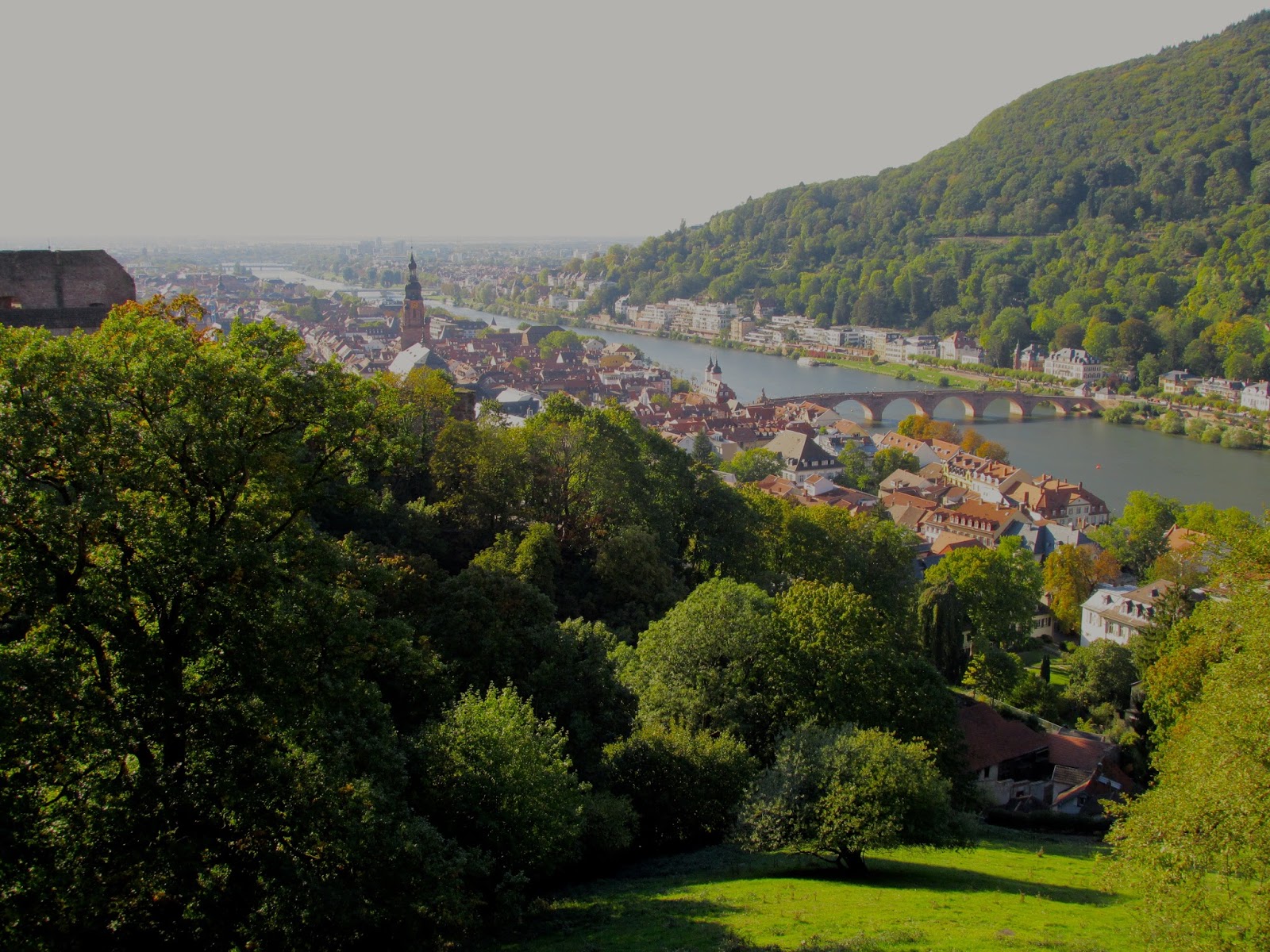
A view of the castle from the garden overlook.


The garden plan was incredibly grand and probably would have rivaled the Gardens at the Palace of Versailles, but it was never completed (war got in the way).  Now it is a lovely place to wander and picnic and enjoy the incredible views of the Neckar River far below.


Time to take a cruise on the Neckar.

There are a number of boats that cruise the Neckar but we are intrigued by the "Neckarsonne", a completely solar-powered craft that's about 120' long (it's so popular that it was expanded not long ago by cutting it in half and inserting another 40' in the hull).


It's an hour-long cruise a short way up the river, a turnaround and a glide down river, turnaround, and back to the dock. Some of the photos along the way . . .


A ginormous barge en route to the Rhine and, I assume, ultimately the Baltic.


Some of the Bauhaus mansions on the opposite side of the river (no doubt, an architectural reaction to the Renaissance and Baroque piles).

One of the many schools of the University which are scattered all over Heidelberg.


A last look down the river . . .

One more touristy activity - a walk over the ancient bridge (visible in that earlier photo) which crosses the river just above the boat landing.  Note the incisor barrier between the two towers!


Neither of us have any idea what the significance of this strange 'participatory' statue is, but Tim willingly stands inside of it for a photo.


A couple more photos of this wonderful town . . .


What an absolutely delightful way to end our stay in Germany.  No wonder Mark Twain spent three months here.  Who said German romanticism was an oxymoron??  

Tuesday, October 6, 2015

Heidelberg, a Students' Town Since 1368

Heidelberg is our last stop in Germany, and it is absolutely delightful.  For starters, we have a fabulous flat (hostess and host, Siggy and Freidemann both speak excellent English) and it's truly fully-equipped:  a clothes washer and DRYER, dishwasher, an ample library of books (in English), cable tv with about 10 BBC channels, fast and reliable internet, and a gorgeous garden (complete with swimming pool which, sadly, is far too chilly to take advantage of).

Down the corridor to the left is the eat-in kitchen and bathroom.

 Since this is a students' town, we start our explorations at the University Museum.  It's impressive - founded in 1386 with the Museum buildings dating from the early 18th century.

This is Germany's oldest university and boasts an impressive 55 Nobel Prize winners (including Joseph Goebbels); we learn that Hitler banned any academics from accepting the Nobel Prize.

The Great Hall is a knockout! It was refurbished/restored in 1886 for its 500th anniversary.


No way either of us can resist the view from the lectern!

There were four original faculties:  religion, law, medicine, and philosophy (the arts were added several centuries later).  


On the list of sights to see in the alstadt is the Student Prison - that got us both intrigued for sure.

This is a most creative take on incarceration.  From our Museum tour, we learn that the townspeople haven't always had a harmonious relationship with the students whom they frequently perceived as spoiled twits and troublemakers.  Obviously things reached a rather serious impasse sometime in the 19th century; something had to be done.  Voila (or whatever it is in German) - put a few of them in 'prison' for a bit (two weeks was the maximum 'sentence').  This was a rather creative solution - they were isolated but could attend classes via a special walkway; they were fed and housed but not nearly as well as non-inmates. With a lot of time on their hands (no nighttime carousing) they turned to decorating the 'rooms'.  And those rooms are now a tourist attraction.


Tim is checking out the list of offenses, one of which he confesses to being guilty of as an undergraduate:  'annoying a professor'.


Apparently, a lot of the graffiti involves caricatures of the professors and fellow students.


And many of them are signed and dated.

Wonder if Tim was contemplating who he would have caricatured??


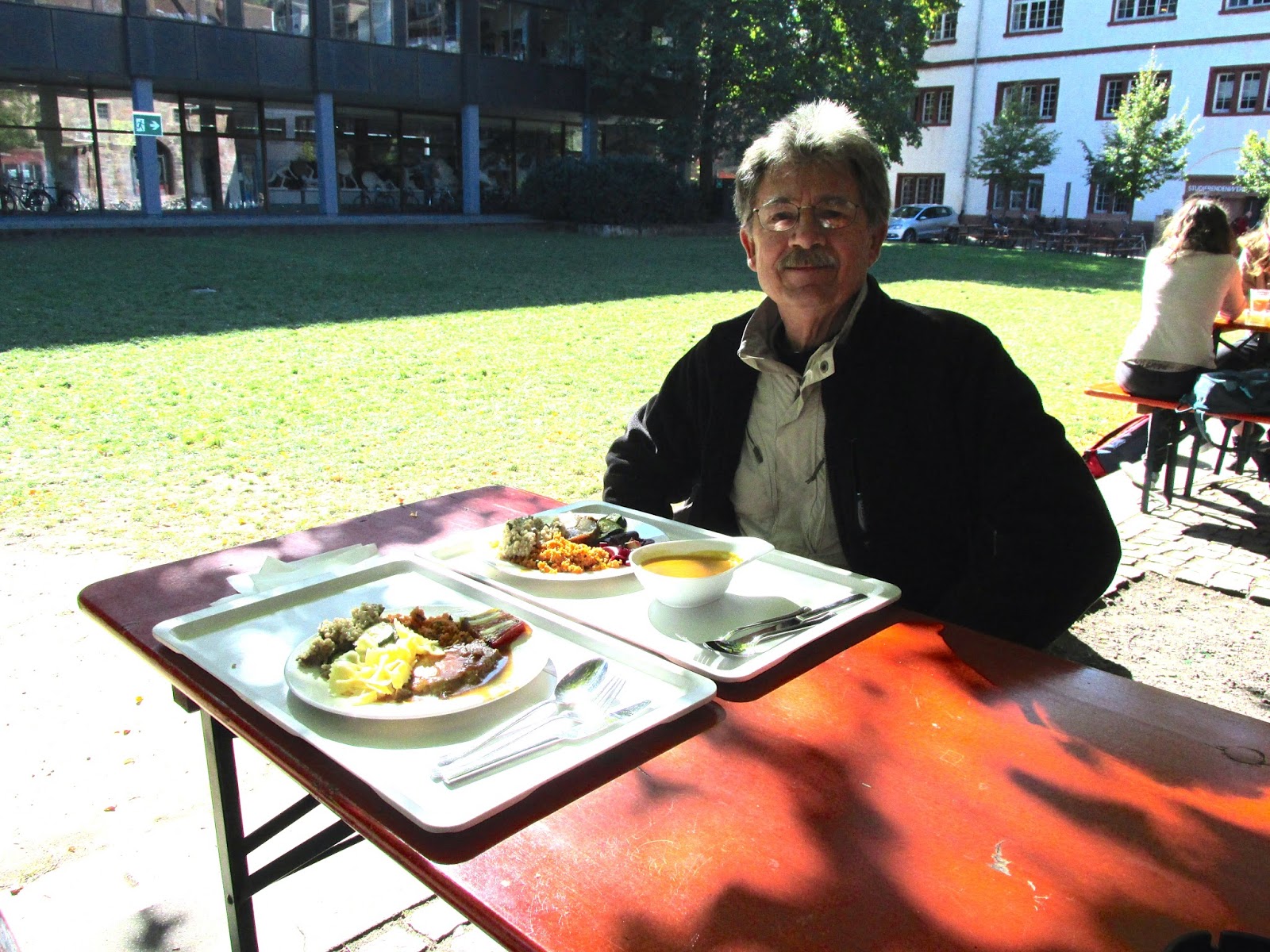
Seems only fitting that we find our way to the student 'cafeteria' for a meal.  After asking a few student-looking types, we find the Zeughaus which is unlike any student eatery either of us knew!


We go through the incredible buffet line (a dazzling array of hot and cold entrees and salads) and a mere 13 euros poorer, take our cream of carrot soup, sauerbraten, noodles and veggies and go sit in the sunshine with the rest of the 'kids'.

And for an extra 6 euros, we get two fabulous lattes and some sort of waist-destroying German cake.


Oh to be a student in Heidelberg!


Sunday, October 4, 2015

And a New Land Speed Record is Set by Herr Kane!

You may remember that our previous jaunts on the autobahn have been somewhat ho hum.  Yes, we did get up to 85mph in a few places, but much of the time we spent crawling through construction sites in lanes barely wide enough to accommodate two cars much less a car and a semi.  No more ho hum . . .

Our trip from Dresden to Heidelberg was a long one - over 6 hours - and the road was surprisingly traffic and construction-free.  A golden opportunity to put our wonderful Citroen diesel to the performance and competition test.  But first, a little bit of autobahniana.

Many of these roads date back to the time of Hitler (one of his grand designs along with the volkswagen - the people's car).  When General Eisenhower took command of Germany at the end of the war, he was very impressed with the road system.  So impressed, in fact, that when he became President he inaugurated the US Interstate Highway system, much of it modeled on the autobahns he'd seen in Germany.  I believe this linkage was not common knowledge, and the US interstate system was promoted as a means of efficiently moving large numbers of troops and equipment across our vast country.  Consequently, the concepts so common to those of us who've driven countless thousands and thousands of miles back and forth across the US are very familiar here.

These are controlled access highways with exits about every 10-15 miles.  Their signs, posted overhead before and at exits, are blue with white lettering, unlike ours which are green and white.  And unlike our interstates, exit numbers are not clearly identified but rather indicated by discreet little signs on the side of the road, kind of like mile markers.  Commercial traffic is heavy, but trucks are limited to the rightmost lane and only occasionally pull out to pass one another.  Some of the autobahns are only two lanes but many are three lanes, and that's where the real fun begins.

We have trucks in the right lane, the center lane is for the 'slower' folk (under 90mph), and the leftmost lane is where anything goes.  For much of the autobahn, there is no speed limit; yes, you read that right, no speed limit.   I cannot tell you how surreal it is to be driving along at 90mph and have a series of cars whoosh by you going what must be 140 or 150mph.  Tim has been really controlled and well-behaved and resisted the impulse to pull into that left lane and catch up to those speedsters!  All it took was a suggestion from me:  'It would be really fun to see what 110mph feels like', and he was in that left lane quicker than a Formula One driver out of the pit.

The Citroen's speedometer maxes out at 280kph which, I think, is somewhere around 160 or 170mph.  No, we didn't get up to that speed but we were pushing 120 (confirmed by the GPS which dutifully keeps track of our speed).  120MPH!!  Let me tell you, that's fast on any speedometer.  And what's so spooky is that after you cruise along at 120 for a few minutes, it starts to feel normal - kind of like 75 or 80 across Texas on I-10.  And, you guessed it, in just a few minutes someone came right up behind us, impatient (no horn blowing here:  just some gut-wrenching, skid-mark generating tailgating) for us to move over so he could pass us - at 120mph!!!

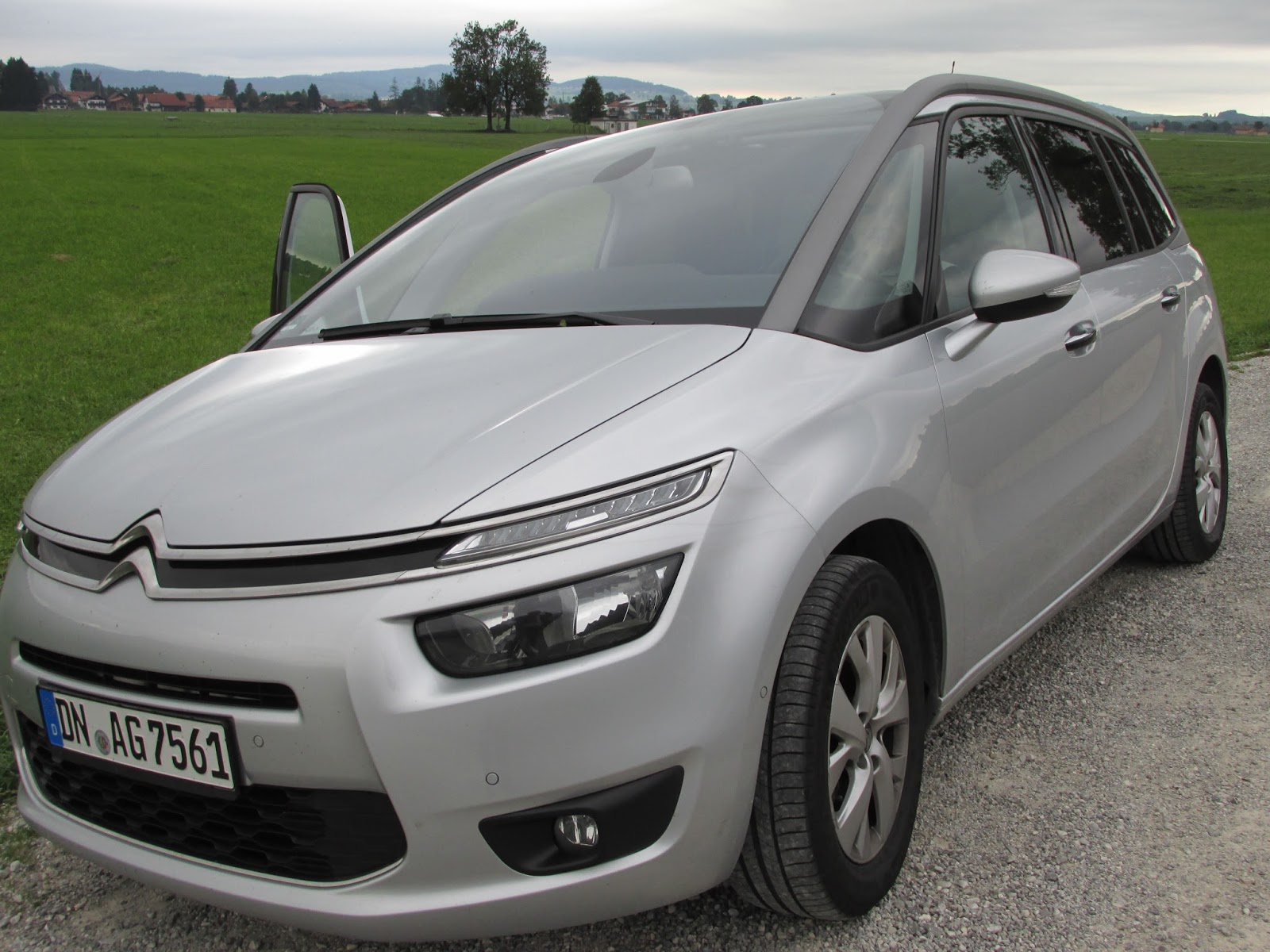
That was sufficient to persuade Tim that he wasn't meant to live life in the fast lane, at least not for long.  A photo of the delightful Citroen:


But we did it - cruised the autobahn at mind-boggling speeds and lived to tell the tale!  Oh p.s., I think our highways are better :)