Saturday, February 14, 2015

The Secret Life of Tim, the Beekeeper

About two thirds of the way down the west coast of the South Island is a large peninsula dominated by Mt. Taranaki.  On our last visit, we hiked in this primeval forest and learned that it has been overrun by possums.  Locals get a bounty for killing them.  There’s even a new fiber blended from merino sheep wool and possum fur called possereno.  I don’t remember why possums have taken over this gorgeous wilderness but having no natural enemies, have become an absolute menace.   They decimated native wildlife and birds (eating their eggs), ruined many native trees and, as a result, are thoroughly detested. 

Judy and Don’s home, in the shadow of Mt Taranaki, is a wonderland of flowers, vegetables, and fruit trees and not a possum in sight.  All of this is heaven for the bees that Don keeps and which he’s eager to attend to as soon as we come back from fishing.  

We’ve already sampled the honey from Don’s hives, and there are no words to describe how wonderful it is.  I slather it shamelessly on toast and muffins at every opportunity.  To satisfy my craving, Tim is more than willing to suit up and help out. 


Apparently, in our short absence, a great number of bees have congregated at the opening to one of the hives, a sign, according to Don, that another hive needs to be installed immediately to prevent a swarm.  Interestingly, there is no evidence of colony collapse syndrome in NZ, which we know has ravaged bee populations worldwide.  These bees are alive and well and producing heavenly honey.


Meanwhile, Judy and I do our hunter-gatherer routine (no special garb required) and harvest tomatoes, beans, beets, broccoli, and lettuce from their abundant garden.  It is nothing short of amazing how well everything grows here . . . this is the end of the season but most gardeners would kill for this yield.  


And the flowers . . .


Tonight is a dinner party and Judy and Don whip up a feast for 13, all friends whom they’ve known since childhood - and us.  We met many of them on our last trip and it’s lovely to catch up . . .


Tomorrow we’ll head up to their bach in Urenui, spend the night and take off for our adventure to the Northlands.   


Thank you so much, Judy and Don, for another memorable visit!

A Clean, Green Country That Works

How often have you read or heard someone say, ‘I’m going to chuck it all and move to New Zealand.’  An announcement frequently followed by:  ‘Where?  I’ve heard of it but I’m not sure I could find it on a map.’  Or the wag’s response:  ‘Don’t they have more sheep than people?’  (no, not Greece where the men are men and the sheep are nervous.)  And, yes, there are more sheep than people (way more) and based on our recent observations, the cows appear to be close to outnumbering the sheep, certainly in the North Island.

But back to why New Zealand has become a metaphor for where life is still idyllic.   It’s clean, it’s green, stuff works, the literacy rate is one of the highest in the world, the school system is good, the social safety net is robust, the military is a token item in the national budget, the middle class is big and thriving, the minimum wage is almost twice what it is in the US, immigrants are assimilated, and while gun ownership is high, gun violence is almost non-existent.  I could go on, and on but you get the idea.  This is one neat nation.

Sure they have their issues, it does sometimes feel a little ‘Nanny State-like’ and people are not happy with a lot that’s happened over the last 10 or so years, but we didn’t meet anyone, anywhere who said:  ‘I’m going to chuck it all and move to . . . ‘ 

This is our third visit in 16 years.  The first in 1999 to visit friends from Washington, DC (NZ natives), the second in 2012 when searching for a place to call home when a move from New Mexico was imminent, and now just cause we’re in the neighborhood.  When we returned home in 1999, we both wanted to pack up and move. (I threatened to move anywhere out of the US if George Bush was elected in 2000.)  When we returned home  after our 2012 visit, we both felt it was just too far from everything, and the only place in the whole country you could find free wi-fi was McDonald’s! 

And here we are in 2015 and I feel like we’ve almost come full circle.  We’re not quite ready to go home and plead our case as émigrés, but this is one terrific country.  

On our previous visits, we managed to cover most of the North Island and a good portion of the South Island, so this visit is short (two weeks).  We’re catching up with friends and ticking a few boxes of places we hadn’t already seen.  First stop, Lake Taupo where we’ll meet up with Judy and Don and do some fishing.  I met Don serendipitously in a parking lot in Silver City in 2007 while hustling memberships to our local arts council.  He and his wife Judy came back to the States and spent a week with us in 2008, and we spent a week with them during our 2012 visit. 

Don has been keen to introduce Tim to the joys of fishing, hence our first stop is Lake Taupo, a gorgeous volcanic lake a 4-hour drive south from Auckland.  

Once we arrive and settle into our comfy motel (all motels in NZ come fully kitted-out with kitchen gear including an electric kettle, egg cups, toast racks, as well as free wi-fi) It turns out that all four of us will be going fishing.   Richard, an old friend of Don and Judy’s, has generously invited us out on his fishing boat.  Off we go to Richard and Dale’s ‘bach’ where we meet the whole family and, in true NZ fashion, are warmly welcomed. 

‘Bach’ is short for bachelor place and harkens back to the days when single NZ guys had a place at the beach to do the stuff US guys do in their man caves except NZ guys did it with fishing poles.  Today a ‘bach’ refers to anyone’s beach or close-to-the-beach vacation digs, often handed down through generations and ranging from a tricked-out trailer to an Architectural Digest palace.  Everyone in NZ seems to have one, and they’re always near water.  Note:  wherever you are in NZ, it’s only 75 miles to some large body of water.

It would be wonderful to report that we were successful and caught something, but alas, we were not.  We did, however, have a perfectly beautiful day on the Lake, toodling around in Richard’s boat, exploring the coastline, marveling at the sapphire blue water, and watching the occasional fish wiggle across  the fish finder screen (I think they were grinning at us as they swam by.) 


Don, Co-First Mate, Captain Richard and Judy, Co-First Mate


We all agree Tim has the laidback makings of a first-rate fisherman.


I, on the other hand, may need some of Tim's relaxed demeanor to get this fishing thing right!

Meanwhile back at the bach, Dale, Richard’s wife, had been preparing a sumptuous dinner for 11, capped by a Pavlova that brought tears to my eyes it was so wonderful.  She graciously agreed to send me the recipe.   


Tomorrow we’re off to Hawera and Taranaki; where there are bees that need keeping at Judy and Don’s.

A Floral Wonderland

Just a short drive from bulavista are the Floral Tropical Gardens.   This has to be one of the best kept secrets on the whole island.  It is spectacular, wonderful, jaw-droppingly beautiful.  Home to over 400 species of palms from all over the world as well as countless cacti, orchids and some of the most spectacular trees we've ever seen, the Gardens were developed by a British horticulturist in the 1990's.  


It is another blisteringly hot, wickedly humid day, but inside the Gardens it's remarkably cool (well, almost!).


The dense foliage . . .


The spectacular view once we climb to the Garden vista . . .


What a perfect way to end our time in Fiji . . .


And after nearly three weeks, we're even better friends than when we started . . . thank you Deb and Paul for enriching our lives and a special thanks to Paul for the 'three fives' almost a year ago in Udaipur, Rajasthan.

We'll see you in Melbourne in February and Tucson in Spring,  2016!!

Thursday, February 12, 2015

A Ramble through the Bush

Our rental of the wee blue vehicle is almost over.  One more excursion is in the cards; this time the West Shore Drive.  Remember we couldn't figure out which direction we were facing (we left that disputed claim back at the overlook)?  Well this will challenge all of us - can we find West Shore Drive?  YES, the four intrepid explorers respond enthusiastically - maps be damned, the course of the sun across the sky, bah humbug!

And with just one 3-point turm we find it!  Is it to our west? Is it on the shore?  Who knows and none of us cares.  It turns out to be a most wonderful 'bush' drive that takes us through a number of tribal settlements where everyone waves enthusiastically - strange cars with Westerners are pretty much a rare spotting.  Amazingly, though, there is a bus that goes up and down this road which must be easily 15 km into the jungle.

We're stopped in our trek by a flooded road that despite Paul's claims that 'we can make that - no bloody problem!', calmer heads prevail.  The decision was enhanced by the sight of a half dozen Fijian maids bathing in the creek - up to their necks!  We content ourselves with a u-turn and a ramble back through what is probably still 'the real Fiji'.

Along the way . . .


A very friendly porker, happily rooting around in the weeds.


This is evidence of a recent burial - don't know the significance of the cloth decoration.

This looks like the bush equivalent of our local AOG church.


Our intrepid driver and infinitely patient navigator.


One last overlook photo before heading home.

Sunday, February 8, 2015

A Most Unusual Sermon

You all know that wherever we travel, Tim and I try and find a local church to attend, and Savusavu is no exception.  This time it’s an AOG (Assembly of God) Church just down the hill from bulavista.   Ana, who cleans and tidies bulavista is a parishioner, along with her whole family, and tells us that things get underway at 11 a.m.

Things are apparently well underway when we show up our first Sunday, and there is no slinking into a back row unnoticed.  The pastor stops his remarks mid-sentence, welcomes us warmly, and insists we take the seats of honor right in the front row (no sneaking out early!).  Then we have to introduce ourselves, and the pastor invites us to ‘testify’.  Well okay now, this is a new one.  Paul and Debbie politely decline the invitation (chickens!!) and then it’s our turn.   Neither Tim nor I are shy or uncomfortable speaking in front of a group and being regular churchgoers, don’t have any difficulty ‘testifying’.  Paul and Debbie, didn’t slither under our wooden bench in cringing embarassment so it couldn’t have been too bad. 

A hymn or two later and we’re into the sermon.  The pastor moves easily between English and Fijian and in one of those seques, Tim and I look at each other – did we really just hear what we think we heard??  Did the pastor just call Mary ‘easy’?  We can’t even look at Paul and Debbie – we can feel the bench shaking with their suppressed giggles.  The pastor went on to praise the Fijians for all the ways they’d modernized in the last 100 or so years including the renouncing of cannibalism (wonder if that was a Lent sort of thing).  Well okay – that certainly is progress in anyone’s book!

After the service we have to meet everyone and take photos.  (Why do I think Paul is musing:  'Jesus Saves . . . at the Royal Bank of Scotland?)


We’re all invited to the AOG New Year’s Eve party.  It's a six-hour celebration,  the first five or so are devoted to cooking (??); I think we’ll be taking a bye on this particular festivity!  A few discreet questions and we clarified the pastor’s characterization of Mary.  Her ‘easy’ nature had nothing to do with her moral state; he was describing her willingness to accept God’s plan for her.  Whew – glad we straightened that out!  PS - did you notice the skirt??

Ana and her three beautiful children and her 'adopted' Dad.


Ana, two of her children, and her husband, the associate pastor, a gentle giant of a man.

A most memorable Sunday church experience. . . 

Tuesday, January 27, 2015

From the Puzzle to the Pitch . . .

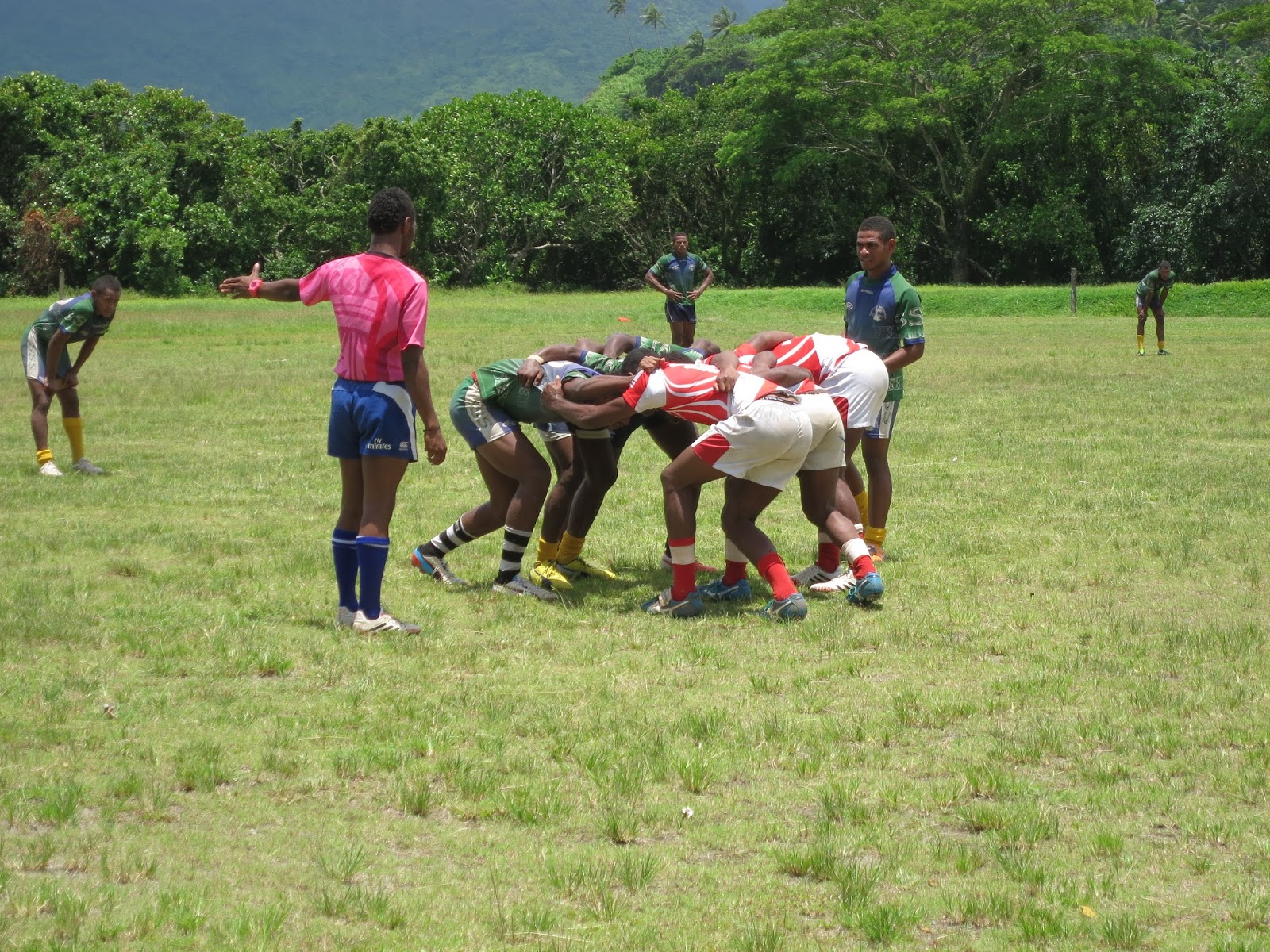
We are avid crossword puzzlers and have easily filled in the five-letter word for 'rugby field maneuver'' with only a dim idea what a 'scrum' was. We are about to find out.  It's Saturday morning and we're off to a real live rugby match - our first ever!!  Paul is delighted (dare I say smug with just a touch of gloating) that after many nights of bridge instruction with us in the know, he is now the rugby expert and we his eager students.

Here he is demonstrating the proper way to throw a rugby ball - a two-handed, sideways, underhand maneuver (executed while running flat out!)


Rugby is a lot like American football but since soccer all over the world is called 'football', rugby is, well, rugby.  I think some British wag described rugby as a bunch of toffs acting like ruffians and soccer as a bunch of ruffians acting life toffs.

At the local rugby pitch (field) four teams are about to face-off for cash prizes in something called '7's'.  Each team has seven players (plus three substitutes) and they play for 10 minutes a half, 20 minutes in total.  It's intense and exhausting (remember it's about 95 degrees and moisture is literally dripping off the banana leaves).  Their gear consists of shoes, socks, matching shorts and shirts.  No helmets, no pads, no face guards, nada; this is bare knuckle ball, folks.  Not for the faint of heart.

This team was warming up and it looked a lot like the hokey pokey to me ('put your left hand in, put your left hand out . . . ')


Paul tells us that the Fijian rugby players are first rate and rank with the best players worldwide.  That's confirmed when a man in the stands (whom we learn is from Brisbane, Australia) is boldly going on the field, taking photos of various players.  Day-Glo baseball cap, next to Debbie - he's a scout.


Paul is a good teacher and we catch on pretty quickly. Object:  get the ball (much like a bloated football) over the end line, score the equivalent of the conversion point(s) and try not to get your self obliterated by a half-ton of high speed flesh in the process.

Back to the scrum - after a minor infraction, four players from each team form a scrum - sort of like a jump ball in basketball only there are eight players competing for the ball rather than two and the ball's on the ground, not in the air.


These eight players huddle in a semi-oval formation, arms around each others' shoulders, heads down and one player puts the ball in the middle of this mass and all the players try and kick it into their portion of the pitch where it can be picked up and run with.  Once the ball leaves the scrum, it's fair game.

It's fast, it's intense, and very demanding - think soccer, coupled with the full-body plays of American football absent all protective gear.  The first game goes quickly, one team clearly dominant, and the next pair of teams takes the field.  That game is halted when a player is carried off the field with what looks like a very nasty ankle injury.  There is one first aid worker with the tiniest first aid kit ever that appears to contain a few bandages and a leather thong for the injured player to chomp down on when she tries to push his ankle back into place!


Not a food or drink vendor in sight - just a whole bunch of locals come to cheer on their teams.

Now, is there a cricket match we can attend??

PS - Scrum is short for scrummage.  Is that where we got the word 'scrimmage'?
PPS - Any errors in my narrative are mine and not attributable to our teacher!

A Very Special Fijian

Maybe, dear readers, you've figured out that our travels are made magical by the people we meet.  I am constantly thrilled and humbled by the kindness and generosity of people we've met all over the world.  Many of these people live on in my imagination, some I hope I've been able to help in some small way (writing a rave review of a restaurant run by the best cook in India struggling to recover from the death of his only son), and still others have come into our lives and remain with us, enriching us beyond measure.

One such person is Sailosi, a Savusavu native, a Fijian man of such intelligence, grace, and gentleness he continues to impress us, even 15+ years after we first met in 1999.  We came here and rented a house in the jungle, sight unseen, and Sailosi was the caretaker who lived a hundred yards or so from our back door.   He made that week memorable.  Every Christmas since we've exchanged cards, caught up on each others' lives, never dreaming that we'd be back.  When we learned that Debbie and Paul were coming to Savusavu, I immediately wrote to Sailosi and included a photo of the four of us so he'd know what Debbie and Paul looked like.

The day they arrived, Sailosi showed up at their door with two hand-made leis to welcome them to the island.  By then we'd decided to join them at bulavista and were eager to reconnect with our old friend.  His caretaking job at the house is long gone (we knew that from his Christmas updates) and he's now caretaking for his long-time employer, Denise (our landlady from 1999) in a building she owns on the main street of Savusavu.

We track him down through one of the shopkeepers and arrange to take him to lunch.  The years have not been kind to him.  Diabetes threatens his extremities, and we are stunned to learn that he is a week younger than Tim.  But the elegant, kindly gentleman is still very much there, and he is thrilled to see us again.


I so wanted him to leave his John Lennon sun glasses and beret on for this photo.  We knew that he was the son of a chief, but we learn now that it was his mother who was the chief!  She was also the one who taught him to play the piano, sent him to private school, and made sure he had tennis lessons.  Later, after retiring from the police force in Suva (on the big island of Viti Levu), he took care of an older gentleman here in Savusavu who introduced him to opera.  And a lifelong love affair began.  His one trip away from Fiji was to Sydney where all he wanted to do was go to the opera - and he did.  He saw Mozart's The Marriage of Figaro.

After lunch we accompany him to the hospital where he has his foot and leg dressings changed daily. We part, promising to get together again with Debbie and Paul who have fallen under his spell too.
We arrange for lunch at another of Sailosi's favorite places, the local Chinese restaurant and, again, see him home in a taxi.  Before parting, we press some money on him (he's far too gracious to refuse) as it's become quite obvious that times are hard for him.  He knows we are leaving in a couple of days and assures us he will come for a goodbye visit.

The day before our departure, he comes up to bulavista.  And, he is bearing gifts.  It appears that he has taken some, if not all, of the money we gave him and bought presents - for us!!  We each get a handmade bracelet, Fiji tee shirts, special shells (he always remembered how fascinated I was by all the shells of Fiji), and I get a necklace, with a beautiful shell.  I get all weepy just writing this . . .

I promise that as soon as we get home, I will make a photo album of our 1999 trip for him, and send along a couple of boxes of Sleepy Time tea (his favorite and not available here), something I'm sad to have forgotten in the rush of departing the US.

Sailosi, you are a dear and special man - thank you for being a part of our lives!